Best AI Trading Tools in 2026: An Honest Buyer's Guide
An honest buyer's guide. What AI can really do for a trader, what it can't, the main categories — and the one distinction that decides whether AI helps you or hurts you.
The best AI trading tools in 2026 fall into four groups: automation bots, analysis co-pilots, AI scanners, and news/sentiment engines. The most important question isn't "which is most powerful" — it's "does this AI make the decision for me, or help me make a better one?" The tools that assist your judgment age far better than the ones that try to replace it.
"AI trading" is the most hyped phrase in markets right now, and most of the hype is nonsense. No AI prints money, and the ones that promise to are the ones to run from. But used correctly, AI genuinely is one of the most useful things to happen to retail trading in a decade — if you understand what it's actually good at. This guide cuts the hype and shows you how to choose.
The four categories of AI trading tools
1. Automation bots
Execute trades for you based on rules or models. Powerful in theory, but they hand control to a black box — and when the market regime changes, they can fail fast and silently. Highest risk category.
2. Analysis co-pilots
Read your chart, explain what's happening, and answer questions — but leave the decision to you. The lowest-risk, highest-learning category. You stay in control; the AI does the explaining.
3. AI scanners
Sweep hundreds or thousands of tickers and surface the ones matching your criteria. A huge time-saver for finding candidates — you still do the analysis on the shortlist.
4. News & sentiment engines
Digest headlines, filings, and social chatter into a fast read of market mood. Great for context — just remember sentiment is one input, not a crystal ball.
The one distinction that matters most
⚠️ AI that drives (autopilot)
Tells you exactly what to buy and sell, or trades for you. Feels effortless — until it's wrong and you have no idea why, because you never learned to read the chart yourself. You're a passenger in your own account.
✅ AI that assists (co-pilot)
Gives you a second opinion, explains the evidence, answers your questions — and hands the decision back to you. You get faster and smarter every session because you're still doing the deciding. You stay in the driver's seat.
Our position is simple and we'll say it plainly: the co-pilot model wins. A tool that tells you what to do makes you dependent and brittle. A tool that helps you understand makes you capable and durable. The goal of good AI in trading isn't to think for you — it's to make your thinking faster and clearer.
How to choose an AI trading tool: a checklist
Does it keep you in control? Prefer tools that inform your decision over tools that make it for you.
Does it explain its reasoning? If a tool can't show why, it's hard to trust — and you can't learn from it.
Is it grounded in real analysis? The best co-pilots read actual indicator data and structure, not vibes.
Does it speak your language? Literally — good AI should explain a chart in whatever language you think in.
Is it honest about uncertainty? Any tool claiming guaranteed accuracy is the wrong tool. Markets are probabilistic.
A co-pilot done right: the AI Quant
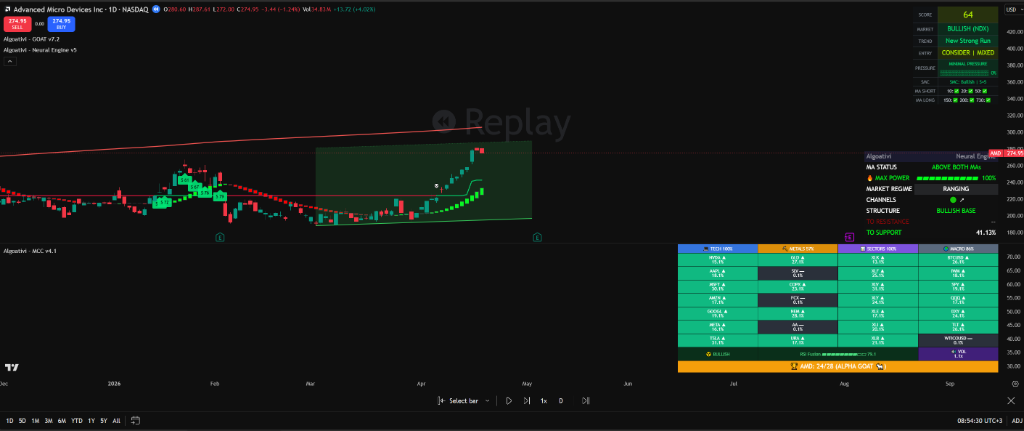
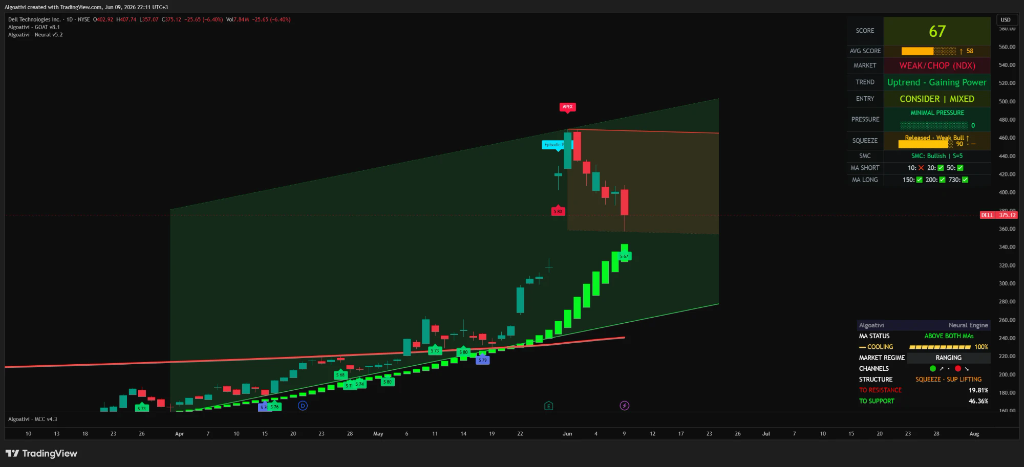
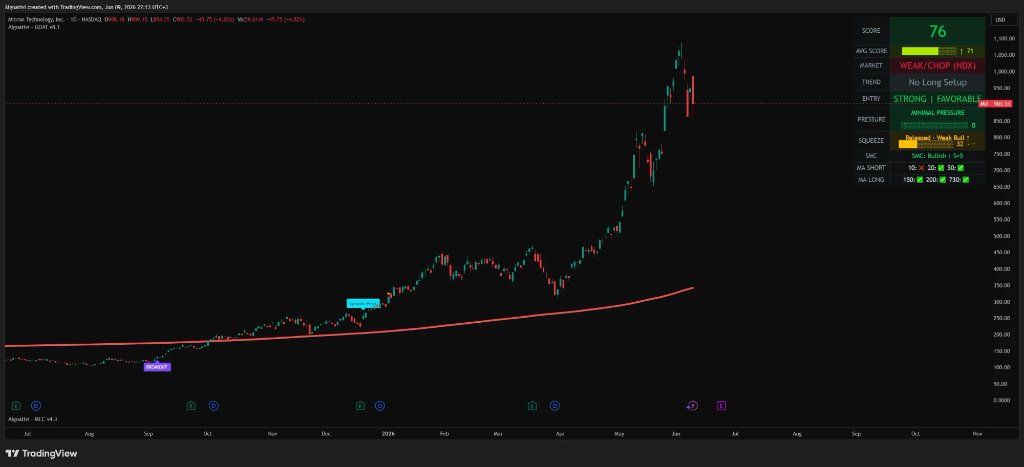
To make this concrete, here's how we built ours. Algoat.TV runs two stacked layers. Layer one is the indicator suite — the G.O.A.T. Toolkit, Neural Engine and Macro Command Center — which is pure quantitative math (no AI inside; the indicators do the calculating). Layer two is the AI Quant co-pilot, which is the AI part.
🧮 The AI Quant — Powered by Anthropic Claude
The bridge is refreshingly simple and entirely in your hands: you take a screenshot of your TradingView chart and paste it into the AI Quant chat. Its vision model reads the indicators on your chart and gives you a second reading of what the math is saying — in any language. There's no automatic API connection feeding it; you are the bridge, which means you're always in control of what it sees and what you do next.
Crucially, it never tells you to buy or sell. It explains, cross-checks, and answers — then hands the decision back to you. That's the co-pilot model in practice.
4 mistakes traders make with AI tools
Trusting a black box. If you can't see the reasoning, you can't catch it when it's wrong. Demand explanations.
Letting a bot run unsupervised. Market regimes shift. Automation that worked last month can quietly bleed this month.
Outsourcing your learning. If the AI does all the thinking, you never develop the skill that actually compounds.
Believing "AI accuracy" claims. No model predicts markets reliably. Treat any guarantee as a red flag.
Frequently asked questions
QWhat are AI trading tools?
Software that uses artificial intelligence to help with trading. They fall into four broad groups: automation bots that trade for you, analysis co-pilots that explain charts, AI scanners that find candidates across many tickers, and news/sentiment engines that summarize market mood. They range widely in risk and usefulness.
QCan AI predict the stock market?
No — not reliably. Markets are probabilistic and influenced by countless unpredictable factors. AI is excellent at reading, summarizing, and explaining data quickly, but any tool claiming to predict prices with high accuracy should be treated with deep skepticism.
QIs it better to use an AI bot or an AI co-pilot?
For most traders, a co-pilot. A bot hands control to a black box and stops you learning; a co-pilot gives you a second opinion and explanations while you keep making the decisions. The co-pilot model makes you a better, more durable trader over time.
QWhat is the AI Quant and how does it work?
The AI Quant is Algoat.TV's analysis co-pilot, Powered by Anthropic Claude. You screenshot your TradingView chart and paste it into the chat; its vision model reads your indicators and gives a second reading of the chart in any language. It explains — it never tells you what to trade.
QDo the Algoat.TV indicators use AI?
No — and this is an important distinction. The three indicators are pure quantitative math with no AI inside them. The AI is a separate layer, the AI Quant co-pilot, that reads the indicators and explains them. The indicators do the math; the AI does the explaining.
AI that helps you decide — not decide for you.
Paste a chart, get a second reading in any language. Powered by Anthropic Claude. Free for 7 days.
🚀 Start Your 7-Day Free TrialDisclaimer: This article is educational and not financial advice. The AI Quant is an analytical tool that explains charts and never provides trade signals, recommendations, or guaranteed outcomes. Algoat.TV indicators are quantitative analysis tools. Trading involves risk of loss. Always do your own research and trade your own plan.